
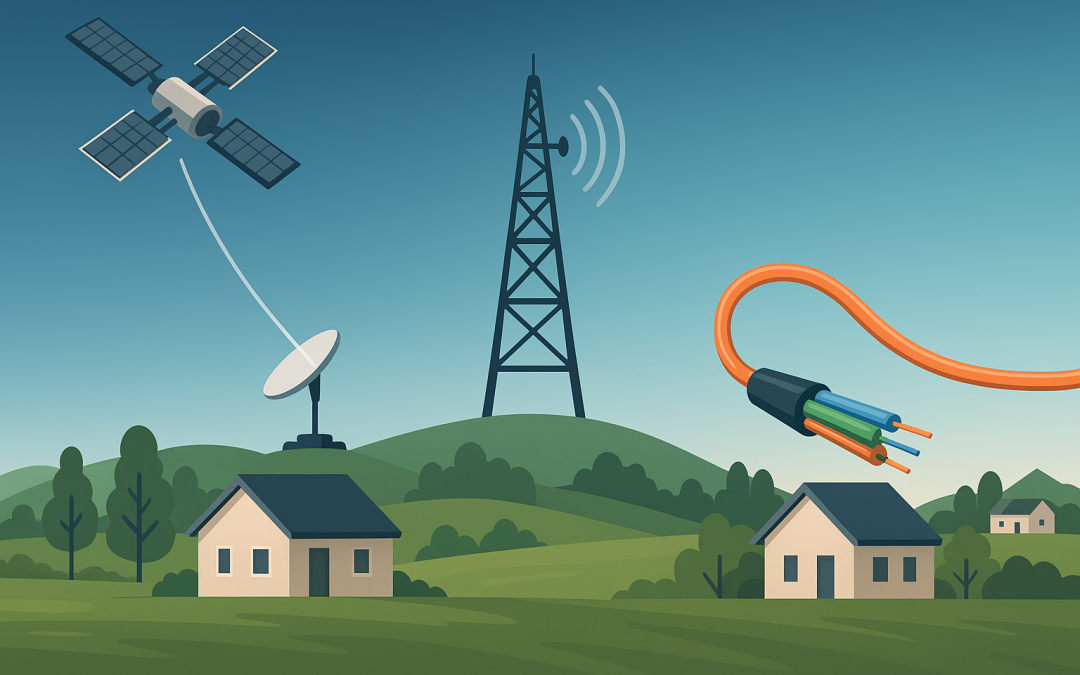
When Starlink first appeared, it promised to revolutionize rural connectivity by bringing fast, low-latency internet to places forgotten by the big providers. And it has helped many families get online. But the bigger story isn’t happening in orbit. It’s happening on the ground, where independent local ISPs are quietly building networks that outperform global systems in value, consistency, and community impact.
This case study explores the performance and economic differences between Starlink, large national carriers, and locally operated ISPs. It also examines an overlooked factor — oversubscription — and how the management of shared bandwidth directly affects the customer experience.
The Changing Broadband Landscape
Fiber
Fiber remains the undisputed benchmark for throughput and latency. It delivers symmetrical speeds, typically between 500 Mbps and 1 Gbps and higher, with latency in the single-digit millisecond range. The issue isn’t performance but reach. Building fiber into rural terrain is slow, expensive, and often financially unviable without subsidies or municipal involvement.
Starlink
Starlink fills part of that gap. By using low-Earth-orbit satellites, it delivers respectable broadband (typically 80–150 Mbps down, 10–25 Mbps up, 30–60 ms latency) nearly anywhere with a clear view of the sky. For the first time, rural and remote customers have a plug-and-play solution that rivals older DSL and wireless systems.
But Starlink’s strength in its global reach is also it's weakness. Each satellite serves thousands of users at once, meaning available bandwidth per region is finite. As adoption grows, so does contention, resulting in the very problem this technology was meant to solve: oversubscription.
Local Fixed Wireless ISPs
Meanwhile, local ISPs have been evolving their networks. Modern fixed wireless systems use fiber-fed towers, high-capacity microwave or millimeter-wave radios, and low-latency routing all owned and maintained locally. They now deliver 100–500 Mbps (and often more) with latency between 10–25 ms. The difference is that these networks are custom built for local conditions, not mass-produced to fit a global model.
Oversubscription: The Hidden Variable
What It Means
Oversubscription is the practice of selling more potential bandwidth than the network can supply simultaneously. It’s necessary — most customers never use their full plan speed all the time — but it’s also the root of performance differences between providers.
If 100 customers each buy a 100 Mbps plan, but only 1 Gbps of total capacity exists, the oversubscription ratio is 10:1. The network operates fine if only a few customers are active and downloading at their capacity at once. But when too many are online such as during evening hours then speed drops, latency rises, and customers start to notice problems.
How It Varies by Provider Type
| Provider Type | Typical Oversubscription Ratio | Customer Impact | Why It Happens |
|---|---|---|---|
| Starlink (LEO Satellite) | ~50:1–100:1 | Noticeable slowdowns and latency spikes during peak hours | Satellite beam capacity is shared regionally and can’t easily scale |
| Large National Fiber ISPs | ~20:1–50:1 | Generally stable, occasional congestion in dense neighborhoods | Cost optimization and shareholder-driven bandwidth planning |
| Local Fixed Wireless ISPs | ~10:1–20:1 | Minimal slowdown; congestion addressed quickly | Smaller scale and local control of capacity upgrades |
| Municipal / Cooperative Fiber | <10:1 | Consistent, near-plan performance | Public or co-op ownership prioritizing reliability |
Why Local ISPs Manage Oversubscription Better
Local ISPs have the advantage of granularity. They know exactly how many customers each tower or backhaul can support. When utilization rises, they can split a sector, upgrade capacity, or add new fiber in days, not months. That hands-on control lets them maintain high service quality even with modest resources.
Starlink, on the other hand, must balance thousands of users across orbital beams and gateways that can’t be reconfigured in real time. When a cell fills up, there’s no quick way to offload users. Customers simply compete for a shrinking share of satellite throughput.
Comparing Real-World Performance
| Metric | Local Fixed Wireless ISP | Starlink (LEO Satellite) | Fiber (FTTH) |
|---|---|---|---|
| Download Speed | 100–500 Mbps typical | 80–150 Mbps typical | 500 Mbps–1 Gbps+ |
| Upload Speed | 25–100 Mbps | 10–25 Mbps | Symmetrical (500 Mbps–1 Gbps) |
| Latency | 10–25 ms | 30–60 ms | 1–10 ms |
| Reliability | 99.9% typical uptime | Susceptible to weather and congestion | 99.999% objective uptime |
| Installation Time | Days to weeks | 1–2 weeks (kit delivery) | Months to years |
| Customer Support | Local, responsive | Remote ticket-based | Centralized call centers |
| Local Economic Impact | Strong — jobs and revenue stay local | None — global HQ | Minimal — corporate operations centralized |
Beyond Performance: Local Value
1. Economic Multiplier Effect
When residents pay a local ISP, that money circulates inside the community leadign to funding local jobs, school partnerships, sponsorships, and network expansion. Every dollar that stays local strengthens the local economy. With Starlink or large telecoms, most of that revenue leaves the region.
2. Local Accountability
Independent ISPs live where they serve. Their technicians and support staff are often one phone call or drive away. Customers deal with people who know the terrain, not overseas call centers. The incentive structure is simple: when customers are also neighbors, service matters.
3. Adaptable Infrastructure
Local networks evolve continuously. Adding a new tower or increasing backhaul from 1 Gbps to 10 Gbps can happen within days. Compare that to national or orbital systems, where even small improvements depend on corporate budgeting cycles or rocket launches.
4. Resilience and Redundancy
A distributed tower network with local backup power and multiple fiber feeds is remarkably resilient. During storms or regional outages, local ISPs can often keep service running even when larger networks fail. Starlink’s resilience depends entirely on ground stations and satellites that can be affected by congestion or weather patterns.
The Role of Fiber in Local Networks
Fiber remains the backbone of modern connectivity and local ISPs rely on it strategically. Instead of running fiber to every doorstep, many rural providers use hybrid designs: fiber to the tower, wireless to the customer. This approach delivers near-fiber speeds without the enormous capital expense of trenching to every home.
In many cases, hybrid networks now support symmetrical 200–400 Mbps connections — sufficient for streaming, gaming, telework, and business operations — at a sustainable cost per customer.
Case Example: A Rural ISP in Action
A local ISP serving about 1,200 homes in a mountainous rural area recently expanded its footprint by building three new 5 GHz and 60 GHz tower sites, each connected to municipal fiber. Within six months:
- 400 homes that previously relied on DSL or Starlink gained stable service.
- Average throughput: 180 Mbps down / 45 Mbps up.
- Latency: averaged 15 ms, even during peak usage.
- Employment: new full-time local technicians hired.
- Economic impact: an estimated $250,000 per year recirculated locally through wages and contracts.
Starlink could have reached the same homes — but not with the same reliability, response time, or benefit to the local economy.
Conclusion
Starlink deserves recognition for pushing broadband boundaries. But its model is inherently global and capacity-limited. The real, lasting value in rural broadband comes from networks built by people who live where their customers do — independent ISPs who combine technical innovation with local stewardship.
Local providers maintain lower oversubscription ratios, deliver faster response times, and reinvest directly into the communities they serve. In short, they create more than internet access — they build self-reliant infrastructure and stronger local economies.
Starlink connects places. Local ISPs connect people — and that’s what makes them indispensable to the future of rural broadband.